FIFA agent salary for beginners: what the job really pays

Football salaries in professional football follow a precise economic logic that every aspiring FIFA agent must master. From the structure of a player contract to the gaps between the Premier League and Ligue 1, via the commission caps set by the FFAR, this pillar article lays the essential groundwork for SportsAgent Institute's "football salaries" cluster. Essential reading to understand the direct link between negotiated salary and agent commission, ahead of sitting the FIFA exam.
Last updated: 02/10/2026
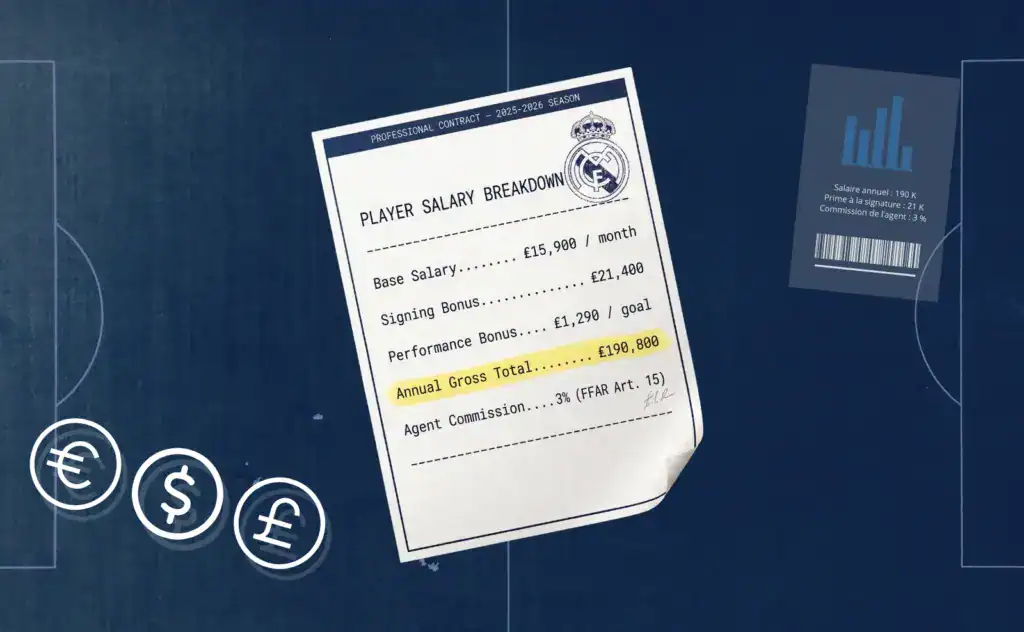
Professional footballers' salaries regularly make headlines in the sports media. Behind every transfer announcement, every contract renewal, lies a complex football salary negotiation that few people truly master. Understanding football salary structures is, first and foremost, a fundamental skill for a player agent.
Mastering the subject of football salary means mastering part of the sports agent profession itself.
A sports agent who understands the remuneration mechanisms in professional football is fully capable of effectively defending their client's interests. This skill also allows them to calculate their own commissions, within the regulatory framework imposed by FIFA since 2023.
How are salaries structured in football? Why do these salaries vary so much from one league to another?
In professional football, a player's football salary is never reduced to a single figure. A player-club contract is a structured document comprising several distinct components. FIFA itself, within the framework of the FFAR (FIFA Football Agent Regulations), provides a precise definition of these elements, which serve directly as the basis for calculating agents' commissions.
A professional player's remuneration generally includes:
The FFAR specifies what remuneration does not include: benefits in kind (company car, housing, telephone), future transfer fees, or resale bonuses are excluded. This distinction matters for an agent, as only the sums included in the regulatory definition count towards the calculation of their commission.
For a player agent, the distinction between what is guaranteed and what depends on performance or the club's context is just as important as the headline gross figure. The higher the variable portion of the contract, the further the player's actual remuneration can stray from the announced amount, which directly changes the basis for calculating the FIFA agent's commission.
This is a point often overlooked by candidates for the FIFA agent exam. Players are not all paid on the same schedule. In the Premier League, weekly payment is the historical norm, hence the "per week" figures that circulate in the British sports press. In Ligue 1, La Liga, or the Bundesliga, monthly payment is standard practice. This detail has practical importance for an agent managing their client's cash flow and anticipating financial flows over the course of a contract.
The football salary gaps between leagues are considerable. A regular starter in the Premier League can earn three to five times more than a player of the same calibre playing in Ligue 1. These salary gaps are largely due to very different economic structures from one country to another.

Three variables explain most of the salary gaps between leagues.
This is the main source of revenue for professional clubs. The Premier League generates substantially more broadcasting revenue compared with other European leagues, allowing English clubs to offer higher salaries than their counterparts in other major championships.
High-capacity stadiums, international partner brands, and commercial tours contribute directly to wage bills. The major La Liga clubs (Real Madrid CF, FC Barcelona) and Premier League clubs (Manchester United, Arsenal F.C.) have considerable financial capacity as a result.
Introduced to contain spending by European clubs, this mechanism (and its successor, the Football Earnings and Cost Control Regulations) requires clubs to maintain a balance between revenue and expenditure, including wage bills.
The table below presents wage bill estimates, sourced from specialist platforms such as Capology. These figures are estimates, not official data published by the leagues themselves.
| Rank | League | Total estimated wage bill (gross/year, USD) |
|---|---|---|
| 1 | Premier League | $3,604,195,728 |
| 2 | La Liga | $2,208,777,056 |
| 3 | Bundesliga | $1,731,091,109 |
| 4 | Serie A | $1,705,177,013 |
| 5 | Saudi Pro League | $1,549,601,081 |
| 6 | Ligue 1 | $1,293,152,151 |
| 10 | MLS | $610,089,074 |
These figures are estimates based on partially verified contracts. Actual salaries vary according to the club, the player's status, bonuses, incentives, and the calculation method used.
This data allows a FIFA agent to determine the career strategy to recommend to a player, identify the clubs to target during a transfer, and anticipate the level of commission applicable based on the negotiated remuneration.
These structural differences have direct consequences for how negotiations should be approached depending on the target market:
The Premier League, with its $3.6 billion wage bill, is the most competitive market but also one of the most contractually stable.
La Liga, dominated by the elite contracts of Real Madrid CF and FC Barcelona, concentrates its highest salaries among a very small number of players. The Bundesliga, by contrast, adopts a more evenly distributed approach between clubs.
Ligue 1, despite a total wage bill of $1.29 billion, remains heavily polarised by the weight of a handful of large contracts. In the same vein, the Saudi Pro League reaches $1.55 billion thanks to a small number of exceptional contracts targeting star players at the peak of their careers.
To round off these examples, MLS, at $610 million, imposes a strict salary cap on its clubs, with a special exemption reserved for a few "Designated Players" whose remuneration far exceeds the cap applied to the rest of the squad.
Mastery of football salary data has become an essential skill in the agent profession. In a market where every negotiation hinges on the ability to argue with figures, an agent who does not use analytical tools can find themselves at a disadvantage against clubs' sporting directors.
Comparing salaries between leagues requires cross-referencing several criteria simultaneously.
For the same gross salary, the net amount received by the player can vary considerably depending on the country's tax regime: a contract in Saudi Arabia, a country with no income tax, differs radically from a contract in France or Germany at an identical gross amount. The total cost to the club includes employer contributions, ancillary benefits (housing, vehicle, image rights), and sometimes the agent's commission, which can push the actual cost well beyond the headline salary.
The local cost of living, the length of the contract, the fixed-to-variable ratio, and the club's financial stability complete the framework a FIFA agent must systematically apply before deciding between two markets.
Capology is one of the most widely used databases for analysing football salaries in professional football. The platform centralises data on individual player salaries and club wage bills, with a clear distinction between verified data and unconfirmed estimates.
For an agent, Capology makes it possible to:
A player's market value as estimated by Transfermarkt is a complementary indicator to salary data. It does not directly determine salary, but it influences an agent's negotiating position. A player whose market value has risen sharply has a stronger argument for securing a pay rise.
The Transfer Matching System (TMS), FIFA's official platform, plays a different role: it ensures transparency and regulatory compliance for international transfers, particularly regarding payments between clubs and to agents. Since the introduction of the FFAR, agents' commissions must be declared and tracked via the TMS by the clubs involved in the transaction.
Salary negotiation is one of the best-known duties of a player agent, but it is also one of the most tightly regulated since FIFA's 2023 reform.
Before entering any negotiation, a FIFA agent must have carried out a precise analysis of their player's position in the market. This involves cross-referencing several data sources:
● Performance statistics from tools such as Wyscout or InStat
● The market value estimated on Transfermarkt
● Salary data available via Capology
The aim is to build a coherent argument, for example: this player, at this level of performance, in this league, should earn remuneration within a certain range. It is on this basis that the agent enters into discussions with the club.
A player's remuneration directly determines what the agent can earn. The FFAR (FIFA Football Agent Regulations) sets strict caps depending on the party represented in the transaction.
FFAR commission caps
| Party represented | Commission cap | Calculation basis |
|---|---|---|
| Player/individual, if annual remuneration ≤ USD 200,000 | 5% | Player's remuneration |
| Player/individual, if annual remuneration > USD 200,000 | 3% | Player's remuneration |
| Buying club/receiving entity, if annual remuneration ≤ USD 200,000 | 5% | Player's remuneration |
| Buying club/receiving entity, if annual remuneration > USD 200,000 | 3% | Player's remuneration |
| Selling club/releasing entity | 10% | Transfer fee |
| Dual representation permitted | 10% if ≤ USD 200,000, 6% if > USD 200,000 | Player's remuneration |
An agent who negotiates a higher salary for their player mechanically increases the basis on which their commission is calculated, within the limits of these caps.
The FFAR also governs negotiating practices. Dual representation must be declared with the agreement of both parties, exceeding the caps is prohibited even if the player or club consents to it, and every payment must be declared via the TMS by the club involved in the transaction. These rules form part of the official study material for the FIFA agent exam.
Two further subtleties deserve an agent's attention. A player's position within the club's internal hierarchy can indirectly weigh on the negotiation, particularly with regard to release clauses and performance bonuses linked to sporting expectations.
Local regulations also alter the general mechanics. In France, the Charte du football professionnel (Professional Football Charter) governs contractual addenda and variable remuneration practices, which directly influences how bonuses are drafted, how commissions are declared via the TMS, and how the agent's mandate is secured.
For the 2025–26 season, the average annual football salary of a Ligue 1 player is estimated at €2,078,485 (£1,805,000) gross, based on 540 players surveyed. These figures show very wide gaps between clubs, with Paris Saint-Germain F.C. alone pulling this figure upwards through its substantial share of the league’s total wage bill.
When a FIFA agent represents a player or the recruiting club, their commission is calculated on the player’s gross remuneration, with certain elements excluded under the FFAR. The rate is capped at 5% for annual remuneration up to USD 200,000, and at 3% beyond that.
The higher a player’s negotiated remuneration, the higher the basis for calculating the agent’s commission, within the limits set by Article 15 of the FFAR. In cases of player representation, the commission is calculated as a percentage of their remuneration, which creates a direct incentive for the agent to maximise the contract, while remaining within the regulatory framework.
Football salaries follow a precise economic logic, directly linked to broadcasting rights, commercial revenue, and UEFA's financial fair play rules. From one league to another, the gaps are considerable: the Premier League alone accounts for an estimated wage bill of more than $3.6 billion, while MLS totals around $610 million.
For an aspiring FIFA agent, this data shapes the career strategy to recommend to a player, the clubs to target during a transfer, and the basis on which commission will be calculated under the caps set by the FFAR.
Understanding football salaries therefore means understanding part of the agent profession — and part of the FIFA exam.