FIFA agent salary for beginners: what the job really pays

The FIFA exam, whose most recent session was held in spring 2026, is a crucial step for aspiring agents and football professionals. Understanding the exam format, its cost and the actual standard of the questions is essential to pass this exam.
Last updated: 13/08/2026
In 2025, 16,117 people submitted an application to FIFA. Only 1,406 of them obtained their licence. The FIFA agent exam remains one of the most selective professional assessments in world sport, and since 2025 FIFA has held only one exam period per year.
The exam consists of twenty questions, lasts sixty minutes, requires 75% correct answers to pass and is based on a syllabus of twenty-six regulatory documents. The format may look simple, but it demands rigorous preparation.
In this guide we look at the dates known so far, how the FIFA agent exam works, its full cost, the languages available, FIFA's official figures and examples of the questions asked on exam day.
As of today, no further FIFA agent exam is scheduled for 2026. The next session should therefore take place in spring 2027, probably between April and June, based on the schedule of previous sessions organised by FIFA.
The information presented below is currently based on the format and schedule of the 2026 session, pending official communications from FIFA regarding the 2027 exam. As every year, FIFA generally publishes information relating to the exam during the month of January.
As soon as FIFA officially announces the new dates and procedures for the FIFA agent exam 2027, the information will be updated.
To prepare successfully, it is essential to follow the official schedule published by FIFA. Missing a date can make it impossible to sit the exam or to change your settings, whether that is the time slot, the location or the language. Here are the key dates of the 2026 session, which serve as a reference point pending the official communications for 2027.
The Football Agents Report published by FIFA in December 2025 gives a precise picture of the exam. The move to an online format caused applications to soar, with 16,117 licence applications, the highest total in its history.
| Indicator | Value |
|---|---|
| Applications submitted | 16,117 |
| Candidates scheduled | 9,148 |
| Candidates present on the day | 7,745 |
| Successful candidates | 1,406 |
| 2025 pass rate | 18% |
| 2024 pass rate | 40.4% |
This 22-point drop in a single year is explained by the increase in the number of candidates made possible by the move to an online format, while the level of difficulty of the exam has remained unchanged. Three further data points also deserve the attention of aspiring football agents:
British agents are those with the highest number of club representations (412), ahead of French agents (382) and Italian agents (313).
With the FIFA football agent exam scheduled for 28, 29 and 30 April 2026, candidates must ensure they are well prepared both for the licensing process and for the exam itself.
The exam is conducted entirely online with remote invigilation, which removes the need for candidates to travel to an exam centre at a FIFA member association. Candidates may sit the exam from any private and quiet location, provided they have the required technical equipment. Public places such as cafés or libraries are not permitted.
The exam must be taken using a laptop or desktop computer fitted with a webcam, together with a smartphone on which the FIFA exam app is installed. The smartphone acts as an additional monitoring device to guarantee the integrity of the exam.
No professional exemptions are granted. Lawyers, accountants and former players sit the exam under the same conditions as every other candidate.
The exam is open-book, but only FIFA's official Study Materials may be consulted in digital format. Printed documents, handwritten notes and external websites are strictly prohibited. Candidates may choose their time slot and the language of the exam within the time limits set by FIFA. Once that period has passed, no change is possible.
To prevent cheating, FIFA applies strict monitoring protocols:
Any attempt to communicate with another person, to access unauthorised documents or to use prohibited items results in immediate disqualification.

A stable internet connection is essential, as FIFA does not provide any technical support in the event of connection problems. If a candidate loses connectivity during the exam, their attempt may be cancelled. No breaks are allowed, including toilet breaks. Leaving the room or closing the exam window brings the session to an immediate end.
The results are published on 4 June 2026, and candidates who do not pass receive a link by email allowing them to review their attempt for three days.
The FIFA exam rules set out all the obligations that apply on exam day.
The format is set by article 6 of the FIFA Football Agent Regulations (FFAR). The most significant change since 2023 is the move to an online exam in 2025.
| Parameter | Official value |
|---|---|
| Number of questions | 20 multiple-choice questions |
| Duration | 60 minutes, i.e. roughly 3 minutes per question |
| Pass mark | 75%, i.e. 15 correct answers out of 20 |
| Value of one question | 5% of the final mark |
| Answers expected | one or more correct answers possible |
| Paper | a unique set generated automatically for each candidate |
If a candidate fails, they must sit the following session, which as things stand means a wait of one year.
Two payments should be budgeted for. The exam fee is payable to FIFA at the time of application, on the FIFA Agent Platform. Since the move to an online format in 2025, FIFA sets and collects it itself, which has put an end to price differences from one country to another. It does not publish the amount on its public pages. It stands at around USD 100, with the applicable figure displayed on the Platform at the time of registration. This payment is a condition of access to the exam, and 4,792 applications were rejected in 2025 for failure to pay within the time limit.
The licence fee, on the other hand, is only payable if you pass. Expect USD 600 for the first year, payable within 90 days of the result, then USD 300 a year before each 30 September. Member associations may not claim any additional fees, unless national law provides otherwise. Any request for payment made outside the FIFA Agent Platform therefore needs to be checked.
Many candidates underestimate the importance of the choice of language. Yet this decision is a strategic one, and it becomes irreversible once the time limit set by FIFA has passed.
For the 2025 session, FIFA offered the exam in four of its official languages, namely English, French, German and Spanish. English was chosen by 55% of candidates, ahead of Spanish on 21%, French on 20% and German on 4%. The choice of language can still be changed up to the deadline in the schedule, set at 29 March for the 2026 session.
FIFA's regulations are drafted in English and then translated. Article 9 of the Statutes lays down the rule: regulations, decisions and official communications are published in English, French and Spanish, and only where this is deemed necessary in the other official languages. Where there is a discrepancy in wording, the English version prevails.
A translated concept can lose precision, and a nuance of drafting can change how a rule reads. The definitions in the FFAR illustrate this, with expressions such as engaging entity or releasing entity whose French or Spanish equivalents do not always cover the same contractual reality. On top of that there is a practical difficulty, since searching for a term in a vocabulary that is not the one used in the question can cost precious time on exam day.
For candidates who have a professional level of English, sitting the exam in English offers three benefits:
This recommendation should be adapted to each candidate's profile. An aspiring sports agent whose legal English remains shaky is far better off sitting the exam in French than adding a language difficulty to the difficulty of the exam itself.
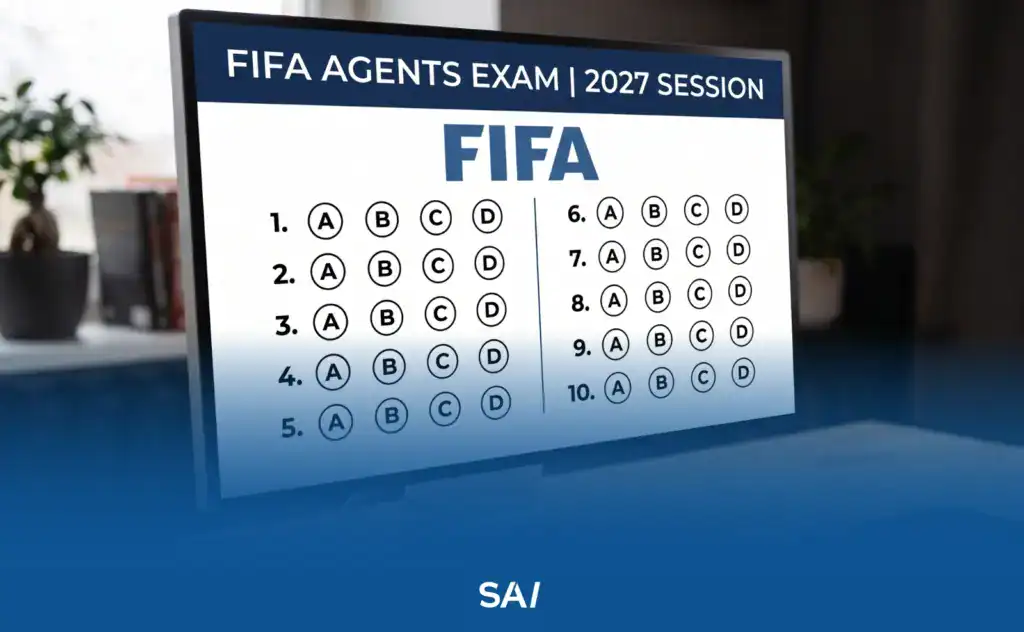
The questions do not test the memorisation of an article, they test the ability to apply a rule to a situation. Here are three examples representative of the level expected.
What is the maximum period of validity of a representation agreement concluded between an agent and a player?

Certain provisions of the FFAR are suspended worldwide following circular no. 1873, but the exam assesses the text as it appears in the official Study Materials. The suspension of its application does not remove the question from the syllabus.
This level of demand is built up through repetition, by working through practice multiple-choice questions that cover the syllabus subject by subject, or mock exams that reproduce the real conditions of the test.
The FIFA agent exam comes in a short format, twenty questions and sixty minutes, but it assesses a syllabus of twenty-six regulatory documents. The figures from the 2025 session show us the gap between the number of candidates drawn to the profession and the number of licences obtained.
A new version published by FIFA does not automatically enter the syllabus for the current session, because only the edition shown in the official Study Materials should be taken into account when revising for the exam. The FIFA Regulations set out the twenty-six documents together with the edition selected for each.
The information available to date is based on the 2026 session. The next one should take place in spring 2027, with no official dates communicated by FIFA at this stage. This waiting period is ideal for putting a regular preparation routine in place rather than concentrating everything into the final weeks.