FIFA Football Tribunal Report 2025/26: A Comprehensive Guide for Aspiring Agents

Having come into force in its latest edition on 1 January 2025, the FIFA Football Agent Regulations (FFAR) impose a mandatory licence, a written representation agreement and a cap on commissions governed by Article 15. This foundational text, at the heart of the study materials for the FIFA agent exam, redefines the conditions for practising as an agent worldwide.
Last updated: 31/07/2026
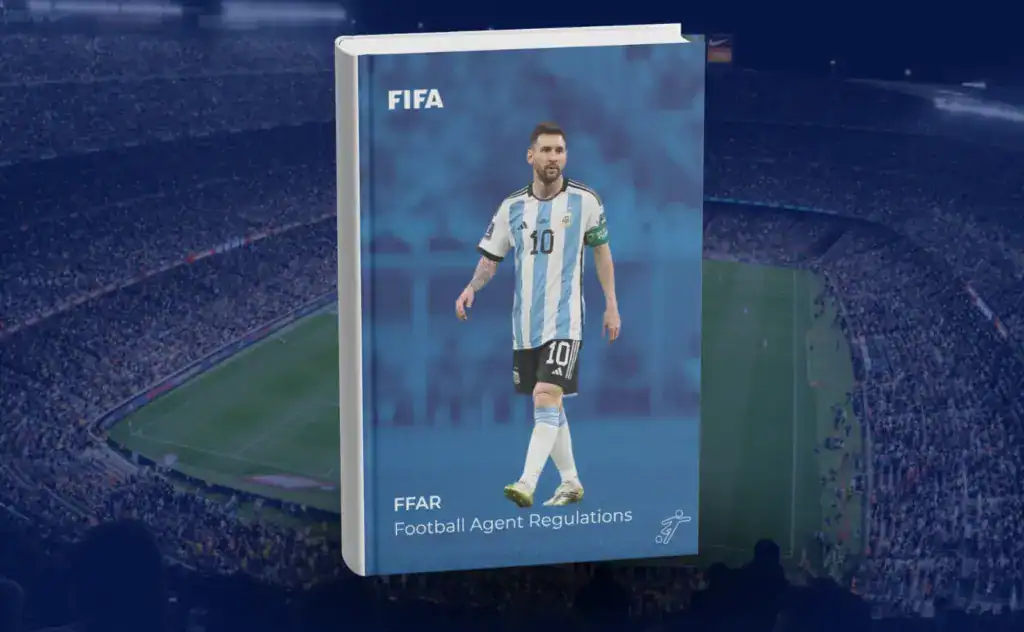
The FFAR (FIFA Football Agent Regulations) is today the key regulatory text for anyone wishing to work as a players' agent on the international stage.
These regulations directly concern candidates sitting the FIFA agent exam, since they set out the conditions for entering the profession, but also every agent already in practice, whose day-to-day activity they govern.
Let us now take a closer look at what the FFAR is, why FIFA chose to introduce it, and what it changes in practical terms for agents.
The FFAR, standing for FIFA Football Agent Regulations, defines the FIFA regulations governing agents. The text was initially approved by the FIFA Council on 16 December 2022, with a first set of provisions applicable from 9 January 2023.
Its implementation, however, was gradual, as FIFA subsequently adapted the application of certain provisions following several legal disputes. The edition currently in force, the December 2024 one, was approved on 10 December 2024 and has been effective since 1 January 2025.
These regulations govern the entire activity of sports agents at international level, defining who may practise, under what conditions, and according to which rules of conduct. In its December 2024 edition, the text is organised into eight chapters, ranging from general rules to final provisions, and covering access to the licence, the exercise of the agent's role and the settlement of disputes.
The FFAR forms part of a wider regulatory framework that every exam candidate must study, alongside other core texts such as the RSTP, the FIFA Disciplinary Code, or the Procedural Rules of the Football Tribunal.
To understand why the FFAR exists, we need to go back ten years. Until 2015, FIFA already imposed a mandatory licence on agents, through the Players' Agents Regulations of 2008.
That same year, the federation opted for a partial deregulation of the profession with the Regulations on Working with Intermediaries. The licence and the exam disappeared, replaced by minimum standards set by FIFA, which each national association then had to apply and enforce at its own level.
Following this deregulation, the market became saturated, conflicts of interest multiplied and the commissions paid soared, reaching nearly $654 million in 2019, roughly four times more than in 2015. FIFA itself acknowledged its mistake, its Chief Legal Officer Emilio García Silvero having described the 2015 deregulation as a "mistake".
It was against this backdrop that FIFA began, as early as 2019, to reflect on re-regulating the profession, culminating in the adoption of the FFAR at the end of 2022.

Article 1, paragraph 2, of the FFAR sets out seven official objectives for the regulations, including raising the professional and ethical standards of the profession, limiting conflicts of interest, improving financial and administrative transparency, protecting players who lack experience within the transfer system.
The FFAR overturns several aspects of agents' daily activity, whether they are already in practice or currently preparing for the licence.
To practise, an agent must now obtain a licence issued by FIFA, following a complete application, good character criteria and passing the FIFA agent exam.
An exam exemption was provided for agents holding a licence obtained under the 1991, 1995, 2001 or 2008 editions of the FIFA Players' Agents Regulations, provided they submitted their application before 30 September 2023 and proved their activity as a registered intermediary between April 2015 and the approval of the FFAR.
This transition period is now closed, so the exam is henceforth an unavoidable step for any new agent.
Once obtained, this FIFA licence is valid worldwide, allowing a licensed agent to offer their services in any country. FIFA also recognises, under certain conditions, the existence of national licensing systems, which makes it necessary to check the compatibility between the FIFA framework and the rules applicable in the country concerned.
The FIFA Agents department handles licence applications as well as the procedures for maintaining licensed agent status, and publishes a publicly accessible list of licensed agents.
The FFAR requires a written representation agreement to be concluded between the agent and their client before any service is provided, specifying the nature of the services supplied and the terms of remuneration.
This representation agreement may not exceed a term of two years when it is concluded with an individual, whether a player or a coach. Any automatic renewal or extension clause beyond this limit is deemed null and void.
Before signing or amending such an agreement, the agent must also inform the represented person in writing that they should consider taking independent legal advice, then obtain written confirmation that this advice has been sought or voluntarily waived.
Article 15 caps the service fee received by an agent according to the type of client represented and the level of remuneration of the individual concerned. The cap varies between 3% and 5% in most cases, up to 10% in the event of authorised dual representation or for a releasing entity on the transfer fee. This provision has long been one of the most contested before European courts.
The Court of Arbitration for Sport had already validated the legality, validity and proportionality of the regulation. The Court of Justice of the European Union in turn ruled on 16 July 2026, confirming that the capping of commissions could be justified under competition law.
An agent may no longer simultaneously represent the selling club, the buying club and the player in the same transaction, except in certain limited cases and with the written consent of the parties concerned.
The regulations distinguish in this respect between so-called releasing entities and so-called engaging entities, with a club, member association or centralised league able to occupy either role depending on the context of the transaction.
The same agent may nonetheless conclude agreements with the same releasing or engaging entity, provided that these agreements relate to separate transactions.
The FFAR creates the FIFA Agents Chamber, a new body responsible for ruling on disputes relating to representation agreements with an international dimension.
Here is how this new framework compares with the former intermediaries system introduced in 2015:
| Aspect | RWI 2015 (intermediaries) | FFAR (since 2023) |
|---|---|---|
| Licence | Not mandatory, simplified registration with the national association | Mandatory FIFA licence, issued after passing the exam |
| Multiple representation | Permitted without strict limitation | Prohibited, except for regulated exceptions consented to in writing |
| Fees | Indicative, non-binding recommendation | Cap of 3% to 10% set by Article 15 |
| Dispute resolution | Handled at the level of each member association | FIFA Agents Chamber for disputes with an international dimension |
| Continuing professional development | Not provided for by the text | Mandatory each year to retain the licence |
On 16 July 2026, the Court of Justice of the European Union (CJEU) delivered an eagerly awaited ruling concerning the FFAR, in the case opposing the agency RRC Sports against FIFA, on referral from the Regional Court of Mainz.
The Court confirms FIFA's authority to regulate the activity of agents and rules that the key elements of the regulation can be justified under competition law:
This validation nonetheless remains a validation in principle. The Court subjects these rules to a proportionality review which it leaves to national courts, and points in passing to certain provisions as potentially problematic, such as the one that deprives an agent of a commission already due when the player is subsequently transferred to another club without their involvement. Whereas the Court of Arbitration for Sport had directly recognised the proportionality of the regulation, the CJEU therefore refers this assessment to national judges.
Above all, the ruling does not reactivate the provisions of the FFAR that had been suspended at a global level (Circular No. 1873). FIFA announced its intention to bring together agents' representatives in the weeks following the decision in order to seek a consensual solution, with a view to the new transfer system planned for 1 January 2027.
The FFAR is one of the texts directly assessed in the examination. The 20 exam questions, to be completed in 60 minutes with a pass mark set at 75%, may relate just as much to the conditions for obtaining the licence as to the rules on representation, the cap on commissions or the workings of the Agents Chamber.
The FFAR is among the documents in the study materials for the FIFA agent exam. Like all official texts included in the syllabus, it must be studied precisely, since the examination assesses candidates' ability to apply all the rules present in the reference materials.
The official text of the FFAR is published by FIFA in several languages, including English.
To prepare for the exam in the best possible conditions, it is important to work directly from the version included in the official study materials for the exam, which corresponds to the edition selected by FIFA for the current session.
Download the FFAR (FIFA Football Agent Regulations) official PDF:

The FFAR marks the return of strict regulation of the agent profession after a decade of deregulation that FIFA itself judged unsatisfactory.
Mandatory licensing, written representation agreements, commission caps, the prohibition of multiple representation and the new Agent Chamber form its pillars, even though the commission cap has long concentrated the challenges before European courts.
Following the Court of Arbitration for Sport, the Court of Justice of the European Union ruled on 16 July 2026 that the key rules of the FFAR could be justified — a validation in principle, which alone is not sufficient to restore the application of provisions that remain suspended at a global level. The duration of representation agreements, meanwhile, remains limited to two years for an individual.
For any candidate sitting the FIFA agent exam, these regulations remain an unavoidable part of the preparation.