FIFA Football Tribunal Report 2025/26: A Comprehensive Guide for Aspiring Agents

The FIFA Disciplinary Code 2026 is not yet part of the FIFA agent exam syllabus. Although it came into force on 1 May 2026, candidates must still study the previous version (2025 edition), which remains the official reference in the exam materials. That said, the 2026 edition offers useful insight into the latest regulatory developments, including stricter sanctions, reinforced anti-discrimination measures, and new obligations for football stakeholders.
Last updated: 08/07/2026
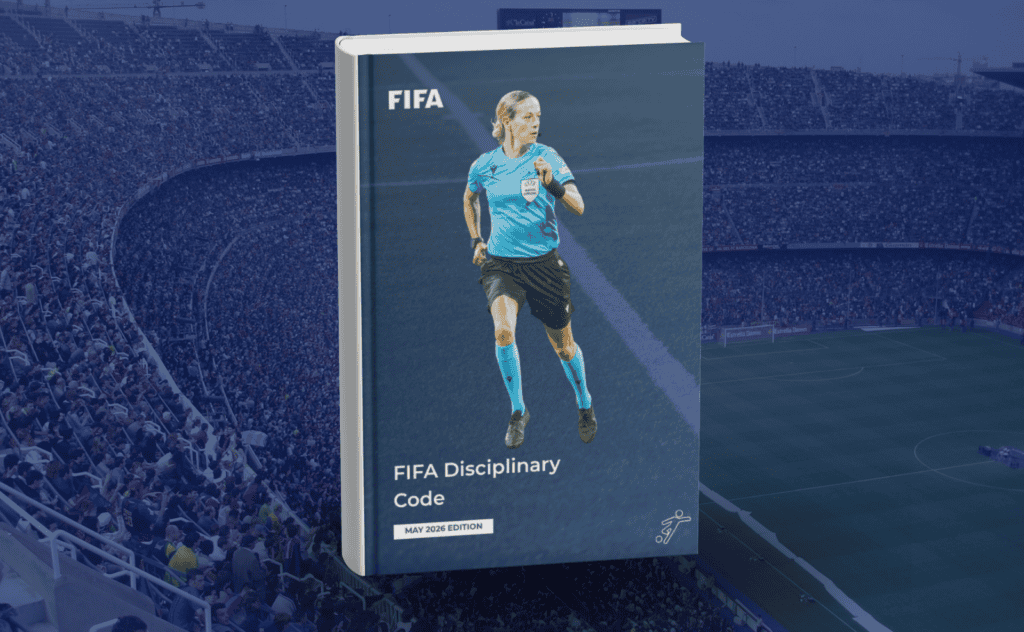
FIFA officially brought a new edition of its Disciplinary Code into force on 1 May 2026. This document governs all offences, sanctions and disciplinary procedures in world football, and is updated on a regular basis.
As with every new version of the Disciplinary Code published by FIFA, candidates for the FIFA agent exam may wonder whether this text needs to be included in their preparation for the official exam.
Let us now look at the importance of this document for the FIFA agent exam, the main developments introduced in this new version, and how to integrate it effectively into exam preparation.
This question is frequently raised by candidates who have become aware of this new version. At present, the FIFA Disciplinary Code 2026 is not yet included in the official study materials used for the players’ agent exam.
FIFA updates its reference documents at regular intervals, but the exam content follows a separate timetable. In practice, it is therefore the previous version of the Disciplinary Code, included in the FIFA-approved study materials, that must be studied for the exam.
The PDF version of the FIFA Disciplinary Code is available with every update on the official “FIFA Documents” page. You can also download it directly below:

Adopted by the FIFA Council on 28 April 2026 and entering into force on 1 May 2026, the new FIFA Disciplinary Code 2026 is the key regulatory text which:
This text applies to member associations, clubs, officials, players, referees, FIFA-licensed agents, match organisers, as well as any person appointed by FIFA to perform an official function.
The document, published in French, English and Spanish (with the English version prevailing in the event of discrepancies), is structured into five main sections and one annex:
| Section | Content |
|---|---|
| I. General Provisions | Scope of application, possible sanctions, limitation periods, reporting obligations and duty to cooperate |
| II. Offences | Breaches of the Laws of the Game, misconduct, match manipulation, failure to comply with decisions |
| III. Organisation and Jurisdiction | Composition of judicial bodies, procedures, evidence, time limits, CAS |
| IV. Special Procedures | Expulsions, suspensions, carrying over cautions, worldwide extension of sanctions |
| V. Final Provisions | Official languages, disciplinary codes of member associations, entry into force |
| Annex 1 | Detailed list of disciplinary measures with financial scales according to the offence and the competition |
Useful Key Figures From the FIFA Disciplinary Code 2026
The FIFA Disciplinary Code 2026 builds on previous editions while strengthening certain key areas in order to better address the current challenges facing football. Here are the main developments:
The 2026 edition includes a detailed Annex 1 listing disciplinary measures by type of offence and by competition (World Cup, men’s and women’s club competitions, youth competitions, futsal, beach soccer and Olympic tournaments).
This schedule now includes:
Article 15 of the Code relating to discrimination and racist incidents remains a central provision of the Code. The three-step procedure (match interruption, temporary suspension, permanent abandonment of the match) is maintained and clarified.
One important point should be noted: the maximum fine for a racist incident directed at an official during a match can now reach USD 5,000,000.
Article 21 of the FIFA Disciplinary Code governs failures to comply with financial decisions issued by FIFA bodies or the Court of Arbitration for Sport (CAS). It specifies the consequences for clubs (ban on registering new players), member associations and individuals, including agents, who fail to meet their financial obligations.
For a licensed players’ agent or a candidate preparing for the 2026 agent exam, the FIFA Disciplinary Code 2026 is not merely a theoretical document. It applies directly to the activities of agents and governs their day-to-day obligations.
Article 3 states that FIFA-licensed agents fall within the scope of application of the text. Any offence, breach of the duty to cooperate, failure to comply with a financial decision or inappropriate conduct may result in disciplinary sanctions.
According to Article 11, any person subject to the Code must immediately report any offence or attempted offence. For an agent, this notably includes approaches related to match manipulation (Article 20). Failure to comply with this obligation may result in a ban from all football-related activity for at least two years.
Article 12 imposes a duty of active cooperation, including responding to requests for information and providing evidence. An agent who refuses to cooperate may face disciplinary sanctions.
The schedule in Annex 1 specifies the fines and deadlines applicable according to the amounts owed. These provisions are directly relevant for agents involved in disputes or proceedings before the FIFA Football Tribunal.
FIFA updates the study materials for the agent exam independently from the publication of its new regulations. This means that a document may officially be in force without yet being included in the exam syllabus.
This is precisely the current situation with the FIFA Disciplinary Code 2026. The version included in the official study materials for the players’ agent exam remains the previous edition.
| Version of the Disciplinary Code | In Force (FIFA) | Included in the FIFA Agent Exam Syllabus |
|---|---|---|
| September 2025 edition | No (replaced) | Yes: must be revised for the exam |
| May 2026 edition | Yes (since 1 May 2026) | Not yet: should be monitored |
Even though the 2026 version is not yet included in the official exam syllabus, keeping track of it still offers several practical benefits for candidates.
The publication of the FIFA Disciplinary Code 2026 is an important development for every candidate preparing for the players’ agent exam. It forms part of the ongoing evolution of FIFA regulations, and every future agent will need to integrate this new framework into their day-to-day professional activities.
However, the priority for exam preparation remains clear: only the version of the Disciplinary Code included in FIFA’s official study materials should be studied for the exam. At present, this is the September 2025 edition.