FIFA Football Tribunal Report 2025/26: A Comprehensive Guide for Aspiring Agents

The FIFA Regulations are the full set of official FIFA rules that govern the agent profession and make up the syllabus for the players' agent exam. They bring together twenty-six documents, ten main subjects and sixteen circulars, from the Statutes to the Football Agent Regulations, taking in the RSTP and the Disciplinary Code. A dense body of texts, regularly updated, and one whose syllabus edition every candidate must master in order to pass the exam.
Last updated: 13/08/2026
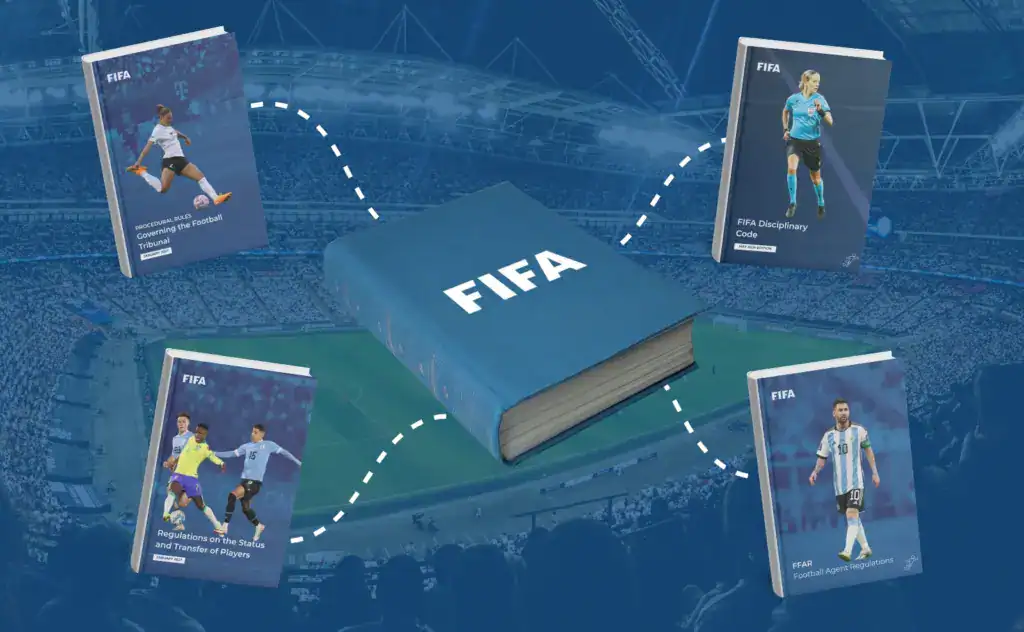
Nearly a thousand pages of legal text, twenty-six official documents and a single objective for the candidate: to master them all before exam day. The FIFA Regulations are the complete body of FIFA rules that govern the profession of football agent and make up the syllabus for the players' agent exam. Statutes, Regulations on the Status and Transfer of Players, Football Agent Regulations, Disciplinary Code, circulars — together, these documents form the regulatory framework that every candidate must master.
Let us now take a closer look at all of these documents, subject by subject, with their purpose, why these regulations change so frequently and how to tell the version currently in force from the one actually assessed in the exam.
The FIFA Regulations bring together all the regulatory texts used by FIFA to organise professional football and to govern the activity of agents. These include the Statutes, the RSTP, the Disciplinary Code, the Code of Ethics and the regulations on football agents.
They are not the Laws of the Game, which fall under the remit of IFAB, but rather the legal framework governing contracts, transfers, discipline, ethics and the profession of players' agent.
For a candidate sitting the agent exam, these regulations make up the entire official syllabus. FIFA's study materials divide them into two sets:
The ten subjects below make up the exam syllabus, and the editions mentioned are those included in FIFA's official study materials.
The RSTP and the Football Agent Regulations alone account for a large share of the questions, but every subject may come up on exam day.
Alongside the ten main subjects there are sixteen FIFA circulars, numbered from no. 1827 to no. 1942. A circular is an official document that publishes, updates or amends a regulation. They form an integral part of the syllabus and also have their own revision page.

It is important to note that if amendments to the FIFA regulations are adopted, or if new regulations come into force, after the publication of these study materials, they will not be included in the exam. Candidates are nevertheless advised to keep abreast of these changes in order to carry out their duties as an agent effectively.
FIFA regulations are constantly evolving, with every season bringing new amendments, editions and circulars. This evolution is mainly explained by the ongoing modernisation of the transfer system and by the legal pressure exerted by the courts.
In June 2026, FIFA and FIFPRO signed a historic memorandum of understanding that redefines the transfer system. Presented as the most significant reform in some twenty years, it is now based on social dialogue rather than on unilateral decisions, and it paves the way for a new transfer system to come into force on 1 January 2027.
This movement has already produced several updated texts. FIFA has notably published the January 2027 edition of the RSTP, new Procedural Rules Governing the Football Tribunal 2027 and a 2026 edition of the Disciplinary Code. These versions mark the evolution of the framework, but they have not yet been incorporated into the official study materials for the exam.
Legal pressure also weighs on the regulation of agents. On 16 July 2026, in the RRC Sports v FIFA case, the Court of Justice of the European Union handed down a nuanced ruling on the FFAR.
It confirmed that several key elements (the licence, the cap on service fees, the ban on multiple representation, the client-pays rule and pro rata payment) may be justified under competition law. It ruled incompatible with that same law the rule preventing an agent from approaching a player already bound by an exclusive representation contract outside the two-month window preceding its expiry, since that rule confers an undue advantage on agents already in place.
This partial validation remains subject to the assessment of the national courts, which will have to verify the proportionality of the rules concerned. It does not automatically reinstate the FFAR, the worldwide application of which remains suspended under circular no. 1873. FIFA has since announced a consultation with agents ahead of the new transfer system planned for 1 January 2027.
All of these texts make up the FIFA Regulations, but the exam does not always cover their very latest version. Two notions must be distinguished.
The version in force is the latest iteration published and applied by FIFA. The version on the syllabus is the edition shown in the official study materials for the current exam session. Amendments and new editions published after that date are not assessed in the session concerned.
| Document | Edition on the exam syllabus | New edition already published |
|---|---|---|
| Regulations on the Status and Transfer of Players (RSTP) | July 2025 | January 2027 |
| FIFA Disciplinary Code | 2025 edition | 2026 edition |
| Procedural Rules Governing the Football Tribunal | January 2026 | 2027 edition |
For the candidate, the rule is simple: revise the edition included in the official study materials for your session, without being thrown off by more recent versions. The latter remain useful to know for future practice of the profession, once the licence has been obtained.
To obtain FIFA's official study materials in PDF format:

The FIFA Regulations form a body of 26 documents that structure both professional football and the agent profession. Ten main subjects and sixteen circulars make up the official exam syllabus, from the RSTP to the Statutes, taking in the Football Agent Regulations and the Disciplinary Code. This framework is changing fast, driven by the reform of the transfer system and by European court rulings.
For candidates, the important thing is to clearly distinguish the version in force from the version on the syllabus. Revising the right version, methodically, remains the key to effective preparation.