Gol International: Pini Zahavi's agency, its players and its model

Moving from sports journalist to FIFA agent is a strategic career change within professional football. Transferable skills, official exam, differences between the professions: discover how to structure your transition and secure your project.
Last updated: 07/05/2026
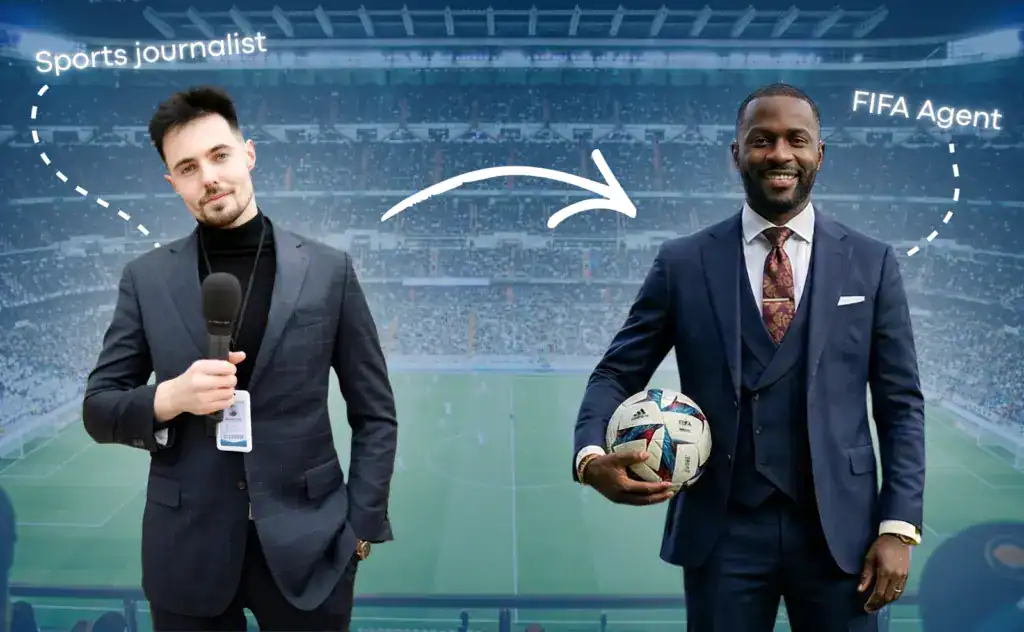
Transitioning from sports journalist to FIFA agent is still a relatively uncommon career move, but it is increasingly being considered by media professionals who specialise in football coverage and the transfer market.
With the introduction of an official FIFA exam required to operate as a licensed agent and the continuous growth of the global player trading market, this path is attracting experienced profiles who are already embedded in the professional game.
For many journalists, this evolution is driven by several motivations: the desire for greater independence, the ambition to support talent over the long term, and the wish to move from simply reporting on transfers to playing an active role in shaping them.
While the roles of sports journalist and FIFA agent share some overlapping skills, they are ultimately built on distinct responsibilities, incentives, and regulatory obligations. Let us explore which skills acquired in sports journalism can facilitate a transition to the profession of FIFA agent, as well as the necessary steps to successfully complete this career change.
Pini Zahavi stands as the benchmark example of a sports journalist who became one of the most influential player agents in modern football.
In the 1970s, he worked as a sports journalist for the Israeli press and used his reporting assignments as a gateway into the inner workings of professional football. His career pivot came in 1979, when he orchestrated Avi Cohen’s transfer to Liverpool, leveraging his privileged relationships with clubs and decision-makers to complete the deal.
Over time, the gap between his initial role as a field reporter and his later stature as the architect behind some of the biggest deals in football became spectacular. Zahavi played a decisive role in Roman Abramovich’s takeover of Chelsea and later in Neymar’s record-breaking move to Paris Saint-Germain, two milestones that reshaped the modern transfer market. His trajectory illustrates how a journalist’s core strength—mastering information and cultivating a highly trusted contact network—can become a powerful engine in the world of player representation and high-stakes negotiations.
As Pini Zahavi’s story shows, one of the main bridges between journalism and agency work is the transformation of a journalist’s rolodex into a commercial and strategic asset. Beat reporters, columnists, and transfer-focused journalists spend years building relationships with club executives, scouts, recruitment departments, coaches, players, and other agents. What starts as a network cultivated for information and stories can, under the right conditions, become the foundation of a career negotiating contracts and transfers.
In the current era, where the sums involved in transfer fees, signing bonuses, and wages are higher than ever, trust and access are priceless. An address book that once guaranteed exclusive stories can, with the necessary regulatory approvals and ethical safeguards, evolve into a platform for positioning players in the right environments and mediating complex multi-party negotiations.
Like FIFA agents, journalists specialising in football develop a deep understanding of the transfer market and the different types of player contracts. This is because they regularly communicate about these topics, particularly during the various transfer windows.
Throughout the season, and especially during transfer windows, their work naturally includes:
Over multiple seasons, this constant exposure helps journalists develop a sharp understanding of how deals are really made, the strategic priorities of different clubs, and the timing and leverage points that matter in negotiations. This same immersion can spark the desire to move from being a commentator on deals to being a direct participant in them.
The recent FIFA reforms introduced a mandatory official exam and a strengthened regulatory framework for player agents. The goal is to standardise practices, improve transparency, and ensure that those representing players and coaches operate under clear, enforceable rules. For professionals already working in football—such as journalists—this new environment can make the profession more attractive by offering:
In other words, becoming a FIFA agent is less about informal “fixing” and more about operating within a structured, heavily regulated global framework, which is reassuring for those looking to build a serious long-term career in player representation.
The move from sports journalist to FIFA agent is not simply about learning new technical content; it also involves repurposing and reframing skills that have already been developed in the newsroom. Several competencies overlap directly with the day-to-day demands of player representation.
Season after season, specialist journalists refine their reading of the football landscape. They follow league dynamics, club investment cycles, tactical trends, and player development pathways across multiple competitions. This analytical mindset is critical for an agent, because representing a player goes far beyond signing the next contract; it requires:
Agents who can articulate this kind of analysis convincingly to both players and clubs gain a competitive edge.
Journalists are trained to verify sources, process complex documents, and explain regulatory changes in accessible terms. Daily, they interpret collective bargaining agreements, federation announcements, and competition rules. For a FIFA agent, similar rigour is required when dealing with:
A journalist’s habit of reading the fine print and cross-checking information can translate directly into a more secure and compliant practice as an agent.
Sports journalists are communication specialists. They understand media timing, how stories are framed, and how public opinion can shift based on what is said—and what is left unsaid. As an agent, this sensitivity becomes an asset when:
Well-prepared agents use communication strategically rather than reactively, something journalists are already used to doing in their editorial work.
Finally, years in the media typically mean years of building relationships. Journalists get to know club decision-makers, intermediaries, staff members, and players’ entourages. In an industry where trust is everything and access is scarce, this pre-existing network represents a serious advantage for any journalist considering becoming an agent.
However, it is crucial to understand that the nature of the relationship changes: instead of extracting information to inform the public, the agent’s role is to represent and defend the interests of specific clients within that same ecosystem. Managing that shift ethically—especially during any overlap between journalism and representation—is essential.
Even though certain skills overlap, sports journalism and agency work are built on very different logics, responsibilities, and economic models. Grasping these differences is vital before committing to a career change.
The sports journalist’s mission is to inform and analyse for the benefit of the public. They gather, verify, and distribute information, and their credibility rests largely on independence and editorial neutrality.
The FIFA agent’s mission is to represent the interests of their clients—players, coaches, or sometimes clubs. Their work is not about informing, but about negotiating, securing the best possible contractual and sporting situations, and advising clients throughout their careers.
Journalists mainly face editorial and reputational risks: corrections, loss of credibility, or potential defamation issues if information is inaccurate.
A FIFA agent operates in a strict regulatory framework involving employment contracts, image-rights agreements, and international transfers, all under FIFA and national association rules. The legal and financial stakes are much greater, and poor advice can have direct consequences on a player’s livelihood and career path.
Between a journalist in the football ecosystem and a sports agent, income is not distributed in the same way.
A journalist typically earns a fixed salary or regular freelance fees, providing relatively stable income.
A football agent’s income depends on commissions derived from negotiated contracts and mandates. The model involves more risk and uncertainty, especially in the early years, when the client base is still small and deals are less frequent.
| Criteria | Sports journalist | FIFA agent |
|---|---|---|
| Main mission | Inform and analyze | Represent and negotiate |
| Positioning | Editorial neutrality | Defense of specific interests |
| Regulatory framework | Journalistic ethics | Official FIFA regulations |
| Income | Salary | Commissions on contracts |
| Responsibility | Media and reputational | Contractual and legal |
| Role in a transfer | Observer and commentator | Actor and negotiator |
Moving from journalism to player representation is a structured process. While many foundational skills are already in place, access to the profession is now formally conditioned on passing the FIFA football agent exam and obtaining the appropriate license.
The FIFA exam is based on a body of study material that compiles several FIFA regulations, including the FIFA Football Agent Regulations and related circulars. For journalists who already follow football governance, the challenge shifts from simply reporting on these texts to mastering them at a professional level. Key areas include:
Developing a structured study schedule—similar to preparing for a bar exam or professional certification—helps convert general familiarity into exam-ready expertise.
FIFA’s licensing exam has quickly gained a reputation for being demanding, with a relatively low global pass rate and strict sitting windows. In 2025, the pass rate was only 18 percent. A failed attempt can mean waiting a full year before taking the exam again, which raises the stakes for each candidate. Given this difficulty, well-organized preparation becomes almost indispensable.
Many aspiring agents choose specialized training programs, such as those offered by institutes dedicated to sports agency education, that provide:
For journalists, this approach mirrors the process of turning background knowledge into deep subject-matter expertise when preparing a long-form investigation or book.
Profiles who have successfully completed their transition demonstrate the feasibility of this path. In an interview with SportsAgent Institute, Jémaël Martial, now a player agent, reflects on the key stages of his evolution toward the profession of agent.
His testimony highlights the importance of rigorous preparation to pass the FIFA exam, and also that becoming a FIFA agent requires professional commitment and a precise understanding of the legal framework.
Passing the exam is necessary but not sufficient. To make the transition truly work, journalists should design a practical business plan that answers questions such as:
This step turns the idea of “being an agent” into a real entrepreneurial project with defined goals, target markets, and operational processes.
For journalists still active in the media while preparing their transition, ethical questions are unavoidable. Transparency with employers, clear boundaries around coverage, and in some cases stepping away from transfer reporting altogether may be necessary to avoid conflicts of interest.
Even after fully leaving journalism, former reporters must be careful to use their past relationships responsibly. The same contacts that once provided off-the-record information now need to be approached with clear, professional mandates and full respect for regulatory rules.
Several real-world examples show that the move from sports media to player representation is not hypothetical—it has been successfully executed by multiple profiles in the professional game.
A former sports journalist, Pape Diouf began as a sports journalist before shifting into player representation and ultimately becoming president of Olympique de Marseille from 2005 to 2009. His trajectory illustrates a gradual climb through the football ecosystem, from media analysis to leadership of a major club.
Jean-Pierre Bernès worked around the sports press and in executive roles before moving into player agency, where his behind-the-scenes knowledge of club operations became a major asset.
Christophe Mongai also worked in the media sector before dedicating himself to supporting professional players. His role evolved over the course of his career and is now more focused on career management and negotiation.
In an interview with SportsAgent Institute, Jémaël Martial—another profile who successfully made the transition—emphasized the importance of rigorous preparation for the FIFA exam and a clear understanding that being an agent requires full professional commitment, not just leveraging contacts on the side.
Moving from sports journalist to FIFA agent represents a coherent evolution for professionals already immersed in the world of professional football. Skills developed in the media—such as deep transfer-market analysis, understanding of contracts and regulations, and the ability to communicate complex situations clearly—form a strong foundation for player representation.
However, the shift in role is substantial. The journalist informs with neutrality; the agent represents and defends the interests of specific clients, often in high-pressure, high-stakes situations. Success in the official FIFA exam is mandatory and requires serious, methodical preparation, particularly on the regulatory and legal fronts.
For sports journalists contemplating this path, the key question is no longer whether the transition is feasible—real examples prove that it is—but how to organize it in a structured, ethical, and sustainable way. With the right preparation, clear boundaries, and a well-defined professional project, the move from the press box to the negotiation table can mark the beginning of a new chapter at the heart of the global football industry.