Global Transfer Report 2025: Key Figures, Market Trends, and Why It Matters for Future FIFA Agents

The Global Transfer Report 2025, published by FIFA, provides an in-depth analysis of the global football transfer market. Using data from the FIFA TMS, this report highlights the economic, geographical and contractual trends of professional and amateur football. A reference document for sports agents and candidates for the FIFA agent exam.

Last updated: 27/02/2026
Ilian Farza
Ilian Farza
Global Transfer Report 2025: Key Figures, Market Trends, and Why It Matters for Future FIFA Agents

The Global Transfer Report 2025 is FIFA’s flagship publication on the international football transfer market. Based on data from the FIFA Transfer Matching System (TMS), it provides a detailed, data-driven look at how players move between clubs worldwide over a full calendar year.

For anyone preparing for the FIFA Football Agent Exam, this report is not just a set of numbers. It is a practical bridge between the regulatory framework you study in the official materials and the way the international transfer system actually operates in the real world.

This article breaks down what the Global Transfer Report 2025 contains, highlights its key figures and trends across men’s, women’s, and amateur football, and explains how candidates can use it strategically when preparing for the FIFA agent exam.

Illustration of the Global Transfer Report 2025

What is the Global Transfer Report 2025?

The Global Transfer Report 2025 is an annual analytical study produced by FIFA. It is built on transactional data recorded in the FIFA Transfer Matching System (TMS), the mandatory online platform used by member associations and clubs to process international transfers and related documentation.

All data in the report relates to international transfers—moves between clubs affiliated to different national associations—completed during the 2025 calendar year. The report consolidates and analyses:

  • The total volume of transfers worldwide
  • Transfer fees and financial flows between associations
  • Types of transactions (permanent transfers, loans, free-agent signings)
  • Contractual details (contract length, first professional contracts, options)
  • Player characteristics (age, nationality, position, status)
  • Geographic patterns of movement (between and within confederations)

Crucially, the report covers three broad segments of the global game:

  • Men’s professional football
  • Women’s professional football
  • Amateur football

Taken together, these segments give a 360-degree view of the international player market and the way the current regulatory framework shapes mobility.

How the Global Transfer Report 2025 Is Structured?: Composition of the Global Transfer Report 2025

The report is organised so that readers can easily isolate trends in a specific segment of the market while still understanding how everything fits within FIFA’s global regulatory architecture. It is composed of four main parts.

1. An introduction to the regulatory and institutional framework

The opening section sets out the regulatory context in which the 2025 transfer year takes place.

A key feature here is the explanation of the interim regulatory framework adopted by FIFA following the Court of Justice of the European Union (CJEU) decision in the Lassana Diarra case. That judgment found that certain provisions of the FIFA Regulations on the Status and Transfer of Players (RSTP)—especially those concerning compensation for breach of contract, joint and several liability, and restrictions linked to the International Transfer Certificate (ITC)—were incompatible with EU law on competition and free movement.

In response, FIFA introduced interim amendments to the RSTP and to the Procedural Rules of the Football Tribunal, clarifying:

  • How compensation for breach of contract should be calculated
  • When and how joint and several liability can apply to a new club
  • The conditions for issuing an International Transfer Certificate when disputes are ongoing

For FIFA agent candidates, this part of the report is valuable because it shows how a major court ruling can trigger rapid regulatory adjustments and how those changes filter directly into transfer practice during the following windows.

2. Men’s professional football

The second part focuses entirely on the men’s professional market, which still accounts for the overwhelming majority of transfer spending worldwide.

This section provides:

  1. The total number of international transfers in men’s professional football
  2. Aggregate transfer fees and comparisons to previous years
  3. A breakdown of types of deals:
    • Permanent transfers with a fee
    • Free-agent signings (players out of contract)
    • Loans and loans with options or obligations to buy
  4. Player profile data: age brackets, positions, and nationalities
  5. Geographic flows of players, both between confederations and between top exporting and importing associations

In addition, the men’s section highlights:

  • The leading spending associations and clubs
  • Associations with the most incoming and outgoing transfers
  • The role of specific pathways (for example, South America to Europe) in shaping the global talent pipeline

For agents, these findings are a practical map of where demand and liquidity are concentrated, and which routes are most active for player careers.

3. Women’s professional football

The third part of the report is dedicated to women’s professional football, a segment that continues to grow at double-digit rates year over year.

The 2025 edition emphasises several major developments:

  • A historic increase in transfer spending in the women’s game
  • Growth in the number of clubs involved in international women’s transfers
  • Rising numbers of professional contracts, longer contract terms, and higher salaries
  • The emergence of consistently record-breaking transfer fees for top players

This section confirms that women’s football is moving rapidly from a semi-professional or underfunded status in many countries to a more structured, investment-driven market, where transfer fees and long-term career planning for players are increasingly the norm.

4. Amateur football

The final section addresses amateur players moving across borders. Even though these transfers largely take place without transfer fees, they represent a huge volume of international mobility:

  • Young players looking for development opportunities
  • Student-athletes combining education and football
  • Semi-professional players moving to lower-tier clubs abroad

This part of the report examines:

  • The total volume of international amateur transfers
  • The average age of players involved
  • The main nationalities represented
  • The countries and federations that act as primary entry points for amateur players

For future agents, this is a crucial reminder that cross-border movement is not limited to elite professionals. Many clients will begin as amateurs or semi-professionals whose career paths cross borders long before their first major contract.

Key figures from the Global Transfer Report 2025

The 2025 report confirms that the global transfer market has reached new historic highs in terms of volume and spending.

Overall Market Snapshot

According to FIFA, 86,158 international player transfers were completed in 2025 across men’s and women’s professional and amateur football—an all-time record. For the first time, total spending on international transfer fees surpassed the USD 10 billion mark, reaching around USD 13.11 billion.

These numbers underline two dynamics:

  • The globalisation of the game, with almost every FIFA member association involved in cross-border player movement
  • The concentration of transfer spending in a relatively small number of elite professional clubs and leagues

Men’s professional football market

In the men’s professional game, the Global Transfer Report 2025 highlights the following key figures:

  • Total number of international transfers: 24,558
  • Total transfer fees paid: USD 13.08 billion
  • Number of clubs involved: 5,283 worldwide
  • Share of transfers with a fee: a record 17.7% of men’s international deals involved compensation

The report also notes:

  • Clubs from England once again led global spending and receipts, spending approximately USD 3.82 billion on incoming transfers and receiving USD 1.77 billion from outgoing deals in 2025.
  • Brazilian clubs topped the rankings for volume, with over 1,100 incoming and 1,000 outgoing international transfers, reinforcing Brazil’s status as the primary exporter and importer of talent in terms of sheer numbers.

In terms of headline moves, several major international transfers grabbed attention in 2025. Based on widely reported fees, some of the largest included:
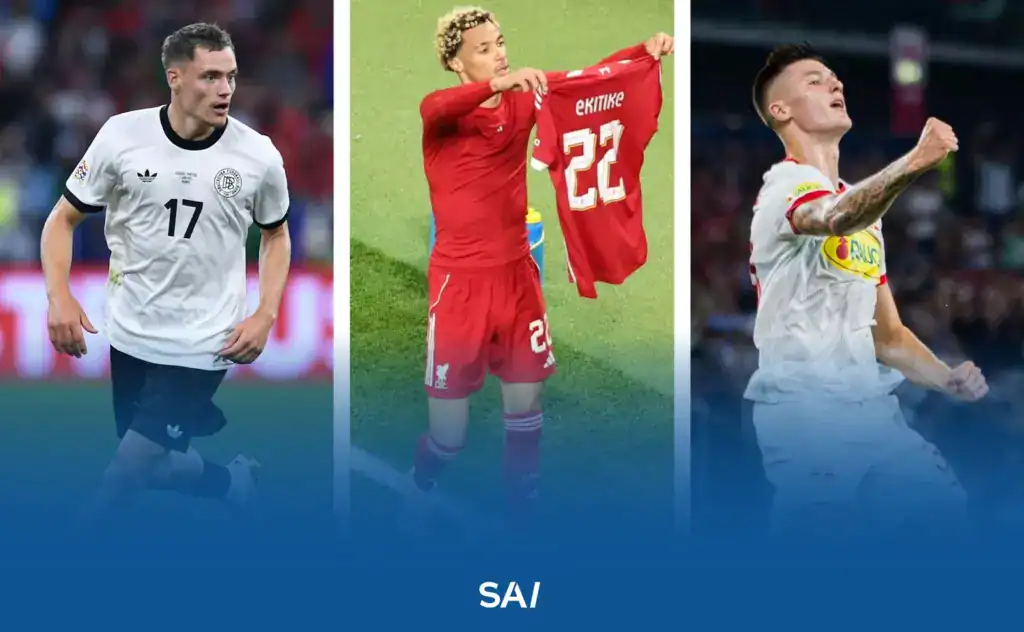
The biggest men’s transfers in the Global Transfer Report 2025. From left to right: Florian Wirtz / Hugo Ekitike / Benjamin Šeško.
  • Florian Wirtz from Bayer Leverkusen to Liverpool – fee packages reported in the region of USD 150–160 million, making him one of the most expensive players in Premier League history.
  • Hugo Ekitike from Eintracht Frankfurt to Liverpool – a deal widely reported at around USD 100+ million including add-ons.
  • Benjamin Šeško from RB Leipzig to Manchester United – a major transfer, with reports placing the final package at over USD 85+ million.

These transfers illustrate a key exam-relevant pattern: elite deals are a small fraction of total transfers but account for a disproportionate share of global spending. Understanding how such deals are structured—release clauses, sell-on percentages, performance bonuses, solidarity contributions—is essential knowledge for agents operating at the top end of the market.

Women’s professional football market

The 2025 report shows that while spending in women’s professional football remains a small fraction of the men’s market, growth rates are significantly higher:

  • Total number of international transfers: 2,440 (up 6.3% year-on-year)
  • Total transfer fees paid: approximately USD 28.6 million, an increase of more than 80% compared with 2024
  • Number of clubs involved: 756, with 135 clubs paying at least one transfer fee, and 155 clubs receiving fees for outgoing players

These numbers are underpinned by a series of landmark transfers that pushed women’s fee benchmarks upwards throughout the year, including:

The biggest women’s transfers in the Global Transfer Report 2025. From left to right: Onema Geyoro / Alyssa Thompson / Lizabeth Ovalle.
  • Naomi Girma from San Diego Wave to Chelsea Women – around USD 1.1 million, breaking the seven-figure barrier for a defender and setting a new benchmark early in the year.
  • Lizbeth Ovalle from Tigres UANL to Orlando Pride – widely reported at around USD 1.5 million, setting a new world record for a women’s transfer at the time.
  • Grace (Onema) Geyoro from Paris Saint-Germain to London City Lionesses – reported at or around the USD 1.9 million (€1.65 million) mark, again raising the global ceiling for women’s transfers.
  • Alyssa Thompson from Angel City to Chelsea Women – reported at approximately USD 1.3–1.5 million in various outlets, becoming one of the most expensive transfers in women’s football and a record for both clubs involved.

Taken together, the data and these high-profile deals send a clear message: women’s football is moving into a phase where transfer fees, long-term contracts, and multi-year career planning are becoming standard at elite level. For agents, this means that knowledge of the women’s market is no longer optional—it is a genuine growth opportunity.

Amateur football market

At amateur level, the Global Transfer Report 2025 underlines just how large the base of the pyramid has become:

  • Total number of international amateur transfers: 59,162
  • Number of clubs involved: more than 25,500 worldwide

The report highlights that:

  • Almost all of FIFA’s 211 member associations were involved in at least one amateur transfer in 2025.
  • Germany again recorded the highest number of incoming amateur transfers, underlining its role as a key destination for players seeking training, education, or semi-professional playing opportunities abroad.
  • Dominant nationalities at this level include French, British, Argentine, German, and Ukrainian players, reflecting both sporting and geopolitical factors.

For aspiring agents, the amateur segment is a reminder that:

  • Pathway management starts early, often before a player signs a first professional contract.
  • Issues such as training rewards and player passports can become relevant later, even when initial moves occurred at amateur level.
  • Understanding how TMS processes amateur ITCs and how national associations handle clearances is directly relevant to everyday agent work.

Summary table of key figures from the Global Transfer Report 2025

CategoryTotal number of transfersTransfer fee amountsClubs involved
Men’s professional football24,558$13.08bn5,283 clubs involved
Women’s professional football2,440$28.5m756 clubs involved
Amateur football59,162N/A (mostly without transfer fees)25,500+
Total global market86,158 transfers$13.11bn-

Why is the Global Transfer Report 2025 important to succeed in the FIFA agent exam?

Although the Global Transfer Report 2025 is not one of the official core documents for the FIFA Football Agent Exam, it is an extremely useful complementary resource. It allows candidates to connect abstract regulatory provisions with real-world behavior in the market.

Here are several concrete ways the report helps you prepare more effectively.

1. Turning Abstract Rules into Real Scenarios

The FIFA study materials set out the rules on:

  • Contractual stability and breaches
  • Training compensation and solidarity mechanisms
  • International Transfer Certificates (ITCs)
  • Protection of minors
  • Loan rules and registration periods

The Global Transfer Report shows how often and in what forms these rules come into play in practice.

For example:

A rising share of transfers with fees (17.7% in the men’s game) shows where compensation-related rules and add-on structures (sell-on clauses, bonuses) are relevant day to day.

The high volume of amateur and youth transfers underlines why FIFA is tightening rules on the international movement of minors and why agents must understand exceptions and safeguards.

Using the report, you can build realistic case studies instead of relying purely on hypothetical examples.

2. Understanding Where the Market Actually Is

The report’s confederation- and association-level breakdowns show:

  • Which countries are net importers or net exporters of players
  • Where spending power is concentrated
  • How pathways (for example, South America to Europe, Africa to Europe, or intra-Asian moves) function in practice

For a future agent, this is invaluable for:

  • Identifying target markets for specific types of players
  • Anticipating visa, work-permit, and adaptation issues
  • Understanding how regulatory changes in one region (such as the Diarra fallout in the EU) can impact global flows over the medium term

3. Preparing for Questions About Regulatory Context

Even if the exam does not directly test you on the Diarra decision, the interim regulatory framework adopted in response is now part of the environment in which agents operate.

The report’s introductory section helps you:

  • See how FIFA positions these interim rules as ensuring clarity and stability during upcoming registration periods
  • Understand which parts of the RSTP are considered most sensitive from an EU law perspective (compensation formulas, sporting sanctions, ITC control)
  • Appreciate that the transfer system is dynamic and may be further modified in response to legal and political pressure

This context is especially useful for open-ended exam questions or practical scenarios that ask you to advise a player or club.

4. Sharpening Your Commercial and Strategic Thinking

The Global Transfer Report is also a commercial intelligence document:

  • For the men’s game, it confirms that a small group of top clubs and leagues dominate spending, while many others rely on free transfers and loans.
  • For the women’s game, it shows that record fees are being driven by a small set of clubs in top leagues (NWSL, English WSL, Liga MX Femenil, etc.), but that the number of clubs willing to pay fees is expanding quickly.
  • For amateurs, it reveals which associations are gateways into certain regions and competitions.

As a prospective FIFA agent, you can use this to:

  • Prioritize markets where your clients are most likely to have realistic opportunities
  • Anticipate salary and fee levels appropriate to different tiers of the market
  • Understand when pursuing a move with a fee is realistic, and when a free transfer plus performance bonuses is likelier to succeed

How to Access and Use the Global Transfer Report 2025 PDF?: Download the Global Transfer Report 2025 PDF

The Global Transfer Report 2025 is an official FIFA publication and is typically available:

  • As a downloadable PDF via the transfer section of FIFA’s official website
  • Complemented by an interactive web platform where you can filter data by association, confederation, or segment of the game

When studying for the exam, it is useful to:

  1. Read the introductory and methodology sections carefully to understand what is included (and what is not) in the data.
  2. Focus on the summaries at the end of each main section (men’s, women’s, amateur) to capture the big-picture trends.
  3. Look up the figures for your own association or confederation, so you can relate global trends to a familiar environment.
  4. Use the data to build mock scenarios: a cross-border free transfer for a 20-year-old, a high-fee move between top European clubs, or a first professional contract in the women’s game.

To download the Global Transfer Report 2025 PDF, click here:

Document icon
Download the Global Transfer Report 2025
Arrow

Additional resources to prepare for the FIFA agent exam

Global Transfer Report 2025, in summary

The Global Transfer Report 2025 highlights a transfer market experiencing strong growth, still largely dominated by men’s football, yet increasingly shaped by the rise of women’s football and ever-growing mobility at amateur level.

Through official and structured data, the Global Transfer Report 2025 provides a clear overview of how the international transfer system operates.

For a players’ agent, this report complements the detailed analyses offered by sports market research platforms such as the Transfermarkt portal, which enables real-time monitoring of player movements and valuations.

For future FIFA agents, this study conducted by FIFA represents an essential reference for understanding market mechanisms and approaching the exam with a concrete and comprehensive perspective.